


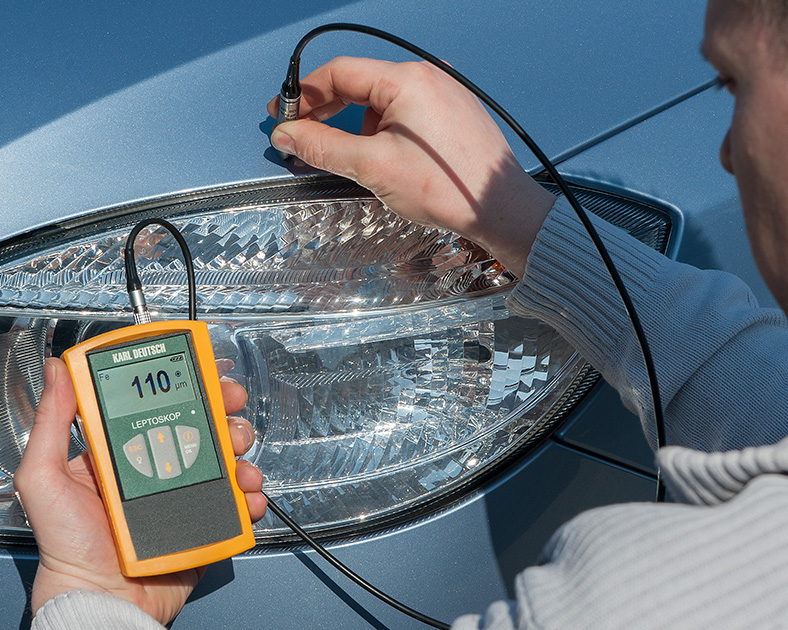
Karl Deutsch LEPTOSKOP 2042 – universal coating thickness gauge with interchangeable probes
Applications
Industrial handheld gauge that, depending on the probe, measures non-magnetic coatings on steel (magnetic induction) and non-conductive coatings on non-ferrous metals (eddy current). Thanks to the wide range of probes – from micro probes to thick-coating probes up to 20 mm – it is suitable for paint shops, galvanising companies and coating quality laboratories.
Key features
- Two methods in one instrument: DIN EN ISO 2178 and DIN EN ISO 2360
- Interchangeable external probes, including 90° and micro probes for hard-to-reach areas
- Backlit graphic display with analogue pointer mode, 10 languages
- Statistics up to 999 values, memory up to 9,999 values in 140 files (depending on configuration)
- Expandable with the “Statistics” and “Statistics and Data Memory” modules, EasyExport and iCom software
- Rubber protective cover, >100 h of battery operation
Models
basic 2042.001; modules 2911.001 (Statistics), 2911.002 (Statistics and Data Memory); packages Fe Basic 2042.901, NFe Basic 2042.902, Fe/NFe Basic 2042.904, Data Fe 2042.921, Data NFe 2042.922, Data Fe/NFe 2042.924
Technical data
- Measuring range: 0–20,000 µm (depending on probe)
- Memory: up to 9,999 values, up to 140 files
- Battery life: > 100 h
- Interfaces: RS232 or USB
Standards
DIN EN ISO 2178, DIN EN ISO 2360, DIN EN ISO 2808 (statistics)
What we offer
- Selection of the instrument and configuration for your task, together with the manufacturer
- Trial measurements of your samples in the manufacturer’s laboratory
- Training, calibration and service organised through the manufacturer
Technical data according to the manufacturer: karldeutsch.de
You might also be interested in
Helmut Fischer DMP10-40 series – universal coating thickness gauges with interchangeable probes
A universal series of handheld gauges for quality assurance in production and in the laboratory – non-destructive coating thickness measurement on ferrous and non-ferrous metals with a very wide range of probes.
Karl Deutsch LEPTO-Pen 2091 – mechanical coating thickness gauge for steel
A simple and economical instrument for quickly checking the thickness of non-magnetic coatings on unhardened commercial steel when the accuracy of an electronic gauge is not needed.

Karl Deutsch LEPTOSKOP probes – interchangeable Fe/NFe probes up to 20 mm
A range of probes for the LEPTOSKOP 2042 gauge that allows a single instrument to measure coatings from a few microns up to 20 mm thick on steel and non-ferrous metals.

Karl Deutsch Pocket-LEPTOSKOP – pocket coating thickness gauge
One of the smallest electronic coating thickness gauges with an integrated spring-loaded probe, designed for quick one-handed checks.
Helmut Fischer DUALSCOPE FMP100 and H FMP150 – gauges with inspection plans
Handheld gauges for complex and regulated measuring tasks in production quality control.
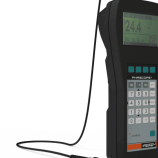
Helmut Fischer PHASCOPE PMP10 – metallic coating thickness gauge for special tasks
A classic handheld gauge for quality control of electroplated and metallic coatings where conventional methods do not work: rough surfaces, small and curved parts, conductive coatings on conductive substrates.
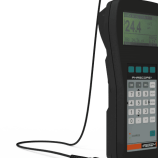
Helmut Fischer PHASCOPE PMP10 DUPLEX – duplex coating thickness gauge
A specialised gauge for duplex systems – paint on galvanised steel – from car bodies to roofing and façade sheet.
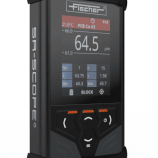
Helmut Fischer SR-SCOPE DMP30 – copper thickness gauge for PCBs
A handheld instrument for electronics manufacturers for measuring the thickness of thin copper layers on multilayer PCBs and laminates without influence from deeper, insulated copper layers.
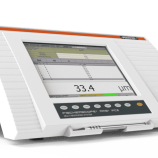
Helmut Fischer FISCHERSCOPE MMS PC2 – modular benchtop measuring system
A universal benchtop system for laboratories and production quality control: coating thickness, electrical conductivity and ferrite content are measured in parallel with one instrument.
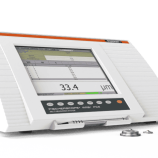
Helmut Fischer BETASCOPE – beta backscatter module for the thinnest coatings
An expansion module for the FISCHERSCOPE MMS PC2 that measures organic and metallic coatings when the atomic numbers of the coating and the substrate differ sufficiently.