


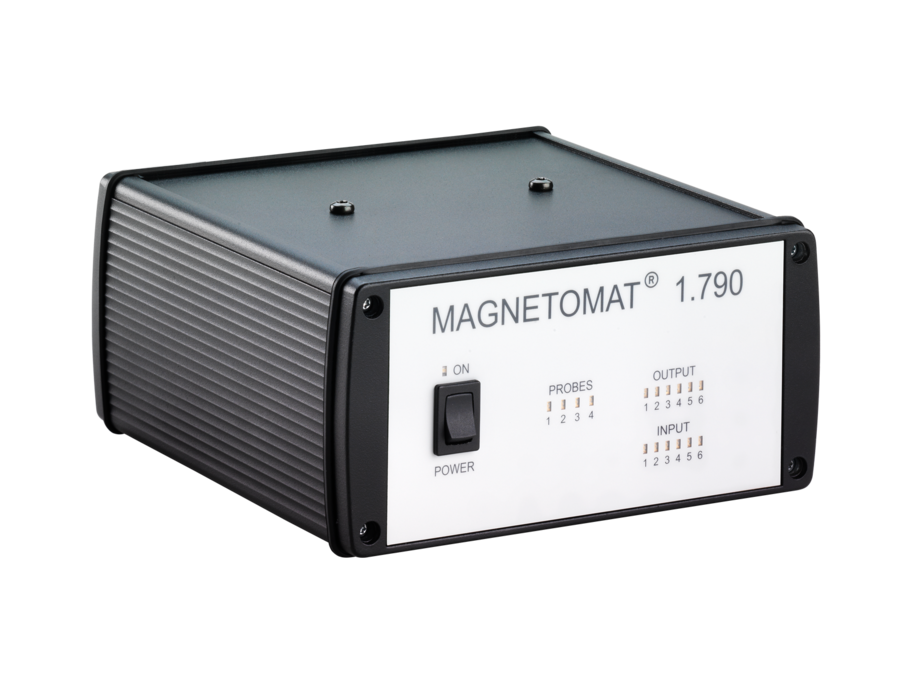
Foerster MAGNETOMAT – 4-channel magnetic field and permeability measuring system
Applications
For monitoring the magnetic environment, checking residual magnetism of parts, detecting ferromagnetic inclusions in stainless steel and non-ferrous metals, and quality control of low-permeability materials. MAGNETOMAT measures static and low-frequency dynamic magnetic fields with fluxgate probes; it is used as a benchtop instrument or mounted on a DIN rail in a control cabinet and integrated into automated measuring systems.
Key features
- Two parameters in one system: magnetic flux density and relative permeability µr
- Up to 4 measuring channels – magnetic field or permeability probes
- Wide choice of fluxgate and permeability probes
- Probes and electronics supplied calibrated with a certificate, automatic probe recognition
- Readings, data storage and export via PC software
- USB, Ethernet, trigger input and up to 6 programmable inputs/outputs
Technical data
| Parameter | MAGNETOMAT |
|---|---|
| Magnetic field range | 100 µT / 1 mT, switchable |
| Permeability range | µr 1.00000–2.00000 |
| Uncertainty | field – 1.5 %, permeability – 5 % of the measured value |
| Channels | up to 4 |
| Resolution / data rate | 24-bit ADC / 2 kHz |
| Interfaces | USB / Ethernet; trigger – incremental encoder, 4–20 mA sensors, digital input |
| Power supply | 24 V DC |
| Operating temperature | 0…+40 °C |
| Electronics dimensions | 190 × 172 × 85 mm |
Standards
STANAG 2897 and AEODP-7, VG 95578, API Spec 7, ASTM A342M (method 4), IEC 60404-15 (section 6).
What we offer
- Selection of the instrument and configuration for your task, together with the manufacturer
- Trial measurements of your parts in the manufacturer’s laboratory
- Training, calibration and service organised through the manufacturer
Technical data according to the manufacturer: foerstergroup.com
You might also be interested in
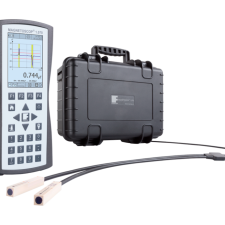
Foerster MAGNETOSCOP 1.070 – portable magnetometer and permeability meter
Portable magnetometer for measuring residual magnetism, demagnetisation, ferromagnetic inclusions and relative permeability µr.